
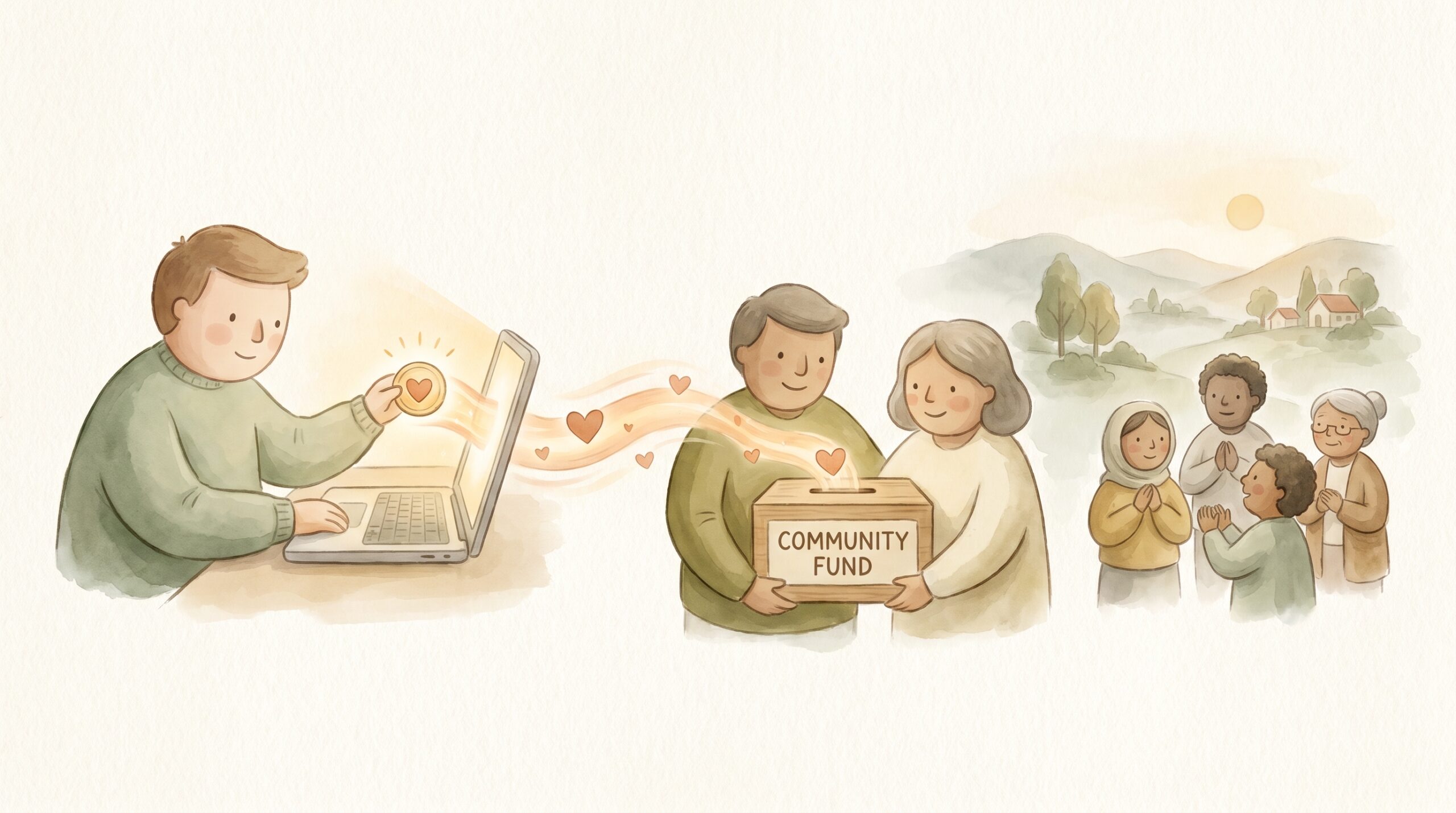
Most donors finish a gift in under a minute. A name typed in, a card number entered, a confirmation page that says thank you. The transaction feels complete.
The question of what actually happens to a donation after that click rarely gets asked. The money seems to go directly to the cause, but the path is longer than the receipt suggests. A donation moves through a framework that records and routes it under specific rules before any disbursement.
For many donors, that middle layer is invisible. The donation goes in. A receipt comes back. What happens between those two events is rarely explained on the giving page itself.
What follows traces that journey — where the gift goes, who holds it, how it is documented, and how it reaches the cause it was intended to support.
What Actually Happens After the Click
A donation page exists at the front of a longer process. The interface that takes a card and shows a receipt is the most visible layer, but it represents only the intake step.
Behind that page sits a payment processor, a charitable host, a record system, and a disbursement workflow. Each layer has its own function and its own accountability.
Donors who understand the full path tend to give with more confidence. The gift becomes a documented event rather than a single moment of trust.
Knowing how a donation is held and released also helps donors evaluate where to give. Two campaigns that look identical on the surface may operate on very different frameworks underneath.
Where the Money Actually Lands
A donation does not move straight from a card to a cause organizer. It first lands inside a 501(c)(3) charitable account that holds the funds for the stated purpose.
In the case of the Community Support Fund, the host is Rekonect, a 501(c)(3) nonprofit partner. The funds sit under Rekonect’s custodianship until they are requested for an approved use.
This intermediate step is not a delay. It is the structure that makes the gift tax-deductible and the use of funds accountable to a third party.
The same principle applies to other BrightLeaf Giving programs. Each one — from a Social Impact Campaign to a long-term fund — routes donations through a qualified charitable framework before any disbursement reaches the field.
Why a 501(c)(3) Custodian Matters
A charitable custodian creates a documented record for every donation that enters the framework. Each gift is tied to a specific fund, a stated purpose, and a known recipient pathway.
Without that layer, a donation is just a peer-to-peer transfer. There is no tax receipt, no compliance trail, and no third party verifying that the money is used as described.
The IRS defines specific operational and recordkeeping requirements for organizations that hold charitable funds. A 501(c)(3) custodian is responsible for meeting those requirements on behalf of every fund it hosts.
That oversight protects donors and organizers alike. A donor’s contribution is bound to its stated purpose. An organizer’s fund is bound to its approved scope. Neither side has to take the other’s word for what happens next.
The custodian also applies consistent rules across all funds. Disbursements are reviewed before they leave the account, which keeps the giving compliant without removing the cause organizer’s intent.
How Donations Are Tracked and Documented
Every donation processed through BrightLeaf Giving is logged with donor name, amount, method, and date. Donors receive a tax receipt that reflects the charitable status of the host organization.
Card, ACH, wire, and donor-advised fund transfers each carry their own processing steps. Each one ends in the same place: a recorded entry tied to the fund it was given to.
A 4.5% donation processing and management fee covers the infrastructure that makes this tracking possible. Wire transfers carry separate third-party fees of $15 domestic or $35 international.
Reconciliation happens regularly across the framework. Donations recorded on the platform are matched against deposits received by the charitable host, and discrepancies are investigated before they affect available balances.
The record matters at year-end. It also matters if a donor, a board, or a regulator ever asks where a gift went and how it was used.
The Difference Between an Informal Gift and a Structured Donation
A direct transfer to an individual organizer is informal. The money moves, but no charitable framework receives it along the way.
A donation through a 501(c)(3) framework is structured. The same money moves, but it is logged, receipted, and held under rules before being released to the approved purpose.
The difference shows up in practical ways. The donor receives a tax-deductible receipt. The cause has a documented funding history. The recipient is identified and approved before disbursement.
For ongoing causes, that difference compounds over time. A structured fund accumulates a documented record that supports credibility, reporting, and future fundraising. That trail also matters when a cause changes hands, since a new organizer can inherit a fund with a documented history rather than starting from scratch.
What Donors Should Look For Before Giving
A clear stated purpose is the first marker of a structured cause. Donors can ask what the funds will be used for and whether that use is on record with a charitable host.
Receipt clarity is the second marker. A legitimate charitable framework issues a receipt that names the host 501(c)(3) and identifies the fund the donation supported.
Disbursement policy is the third. Funds that move only after a documented request and review are operating under accountability. Funds that move freely without review are not.
These markers do not require insider access. A donor does not need to audit a cause to give responsibly, and a few questions or a closer look at the receipt structure usually surface the answer.
How the Community Support Fund Works with BrightLeaf Giving
The Community Support Fund is the long-term program for ongoing causes that need a stable place to receive donations. The path from gift to disbursement follows a consistent process.
- Apply with a stated use of funds. The cause organizer submits an application that describes the ongoing mission and the intended use of donations under the fund.
- Receive approval and launch. Once the application is approved, the fund goes live under the Community Support Fund framework hosted by Rekonect.
- Accept donations through multiple giving methods. Donors can contribute by card, ACH, wire, or donor-advised fund. Each gift is logged and receipted under the fund’s charitable host.
- Submit requests for the approved use. When the cause needs to spend funds, the organizer submits a disbursement request tied to the approved purpose on file.
- Complete review before disbursement. The request is reviewed against the stated use of funds, then issued to the qualified recipient or vendor through documented channels.
Conclusion
A donation is not just a transaction. It is the start of a documented path that runs through a 501(c)(3) framework, a record system, and a review process before reaching the work it was meant to support.
Donors who understand that path tend to give more intentionally. They know the gift is held, tracked, and disbursed under rules that protect both the cause and the contribution.
The click is the moment of generosity. The framework behind it is what makes that generosity accountable, repeatable, and credible over time.
Your Next Step
Review how the Community Support Fund works, including the application process, donation methods, and disbursement request flow. If you have questions, reach out to BrightLeaf Giving to get your answers.
Visit https://brightleaf.giving/nonprofit/startup/ to learn more, or contact the team at brightleaf.giving/contact/.