
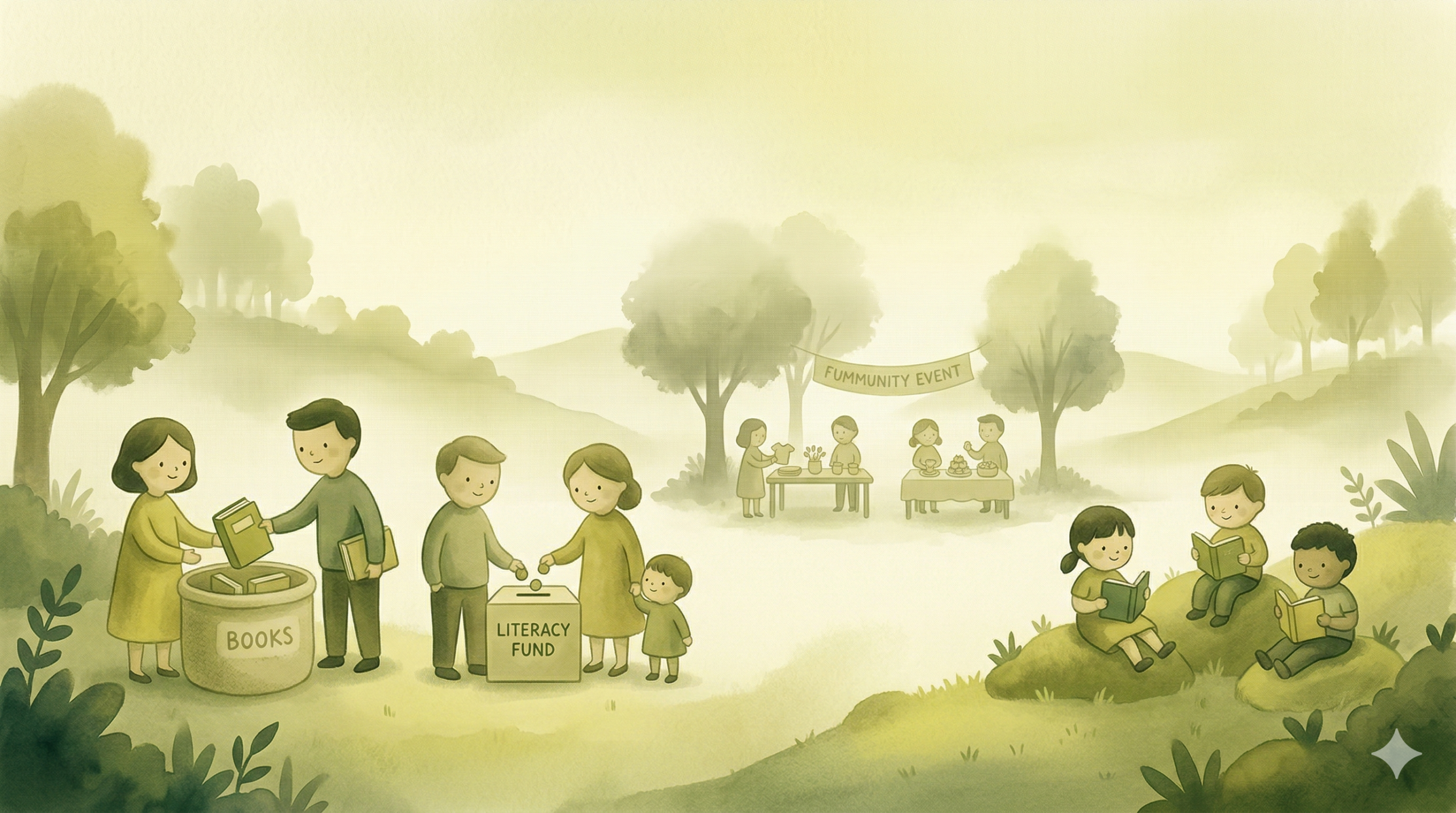
Literacy work rarely succeeds through one event alone. One book fair can place books into homes, and one reading night can bring families into a school or community center. Even so, the larger need remains.
Books have to keep circulating. Reading support has to continue beyond one date on the calendar. Community groups also need materials, volunteers, and a way to keep the work moving.
That is where a fundraising program becomes useful.
A fundraising program creates an ongoing structure for raising and managing money across related efforts over time. Donations stay organized, use of funds stays documented, and local support can continue from one need to the next.
Why Literacy Efforts Need Ongoing Support
You will not solve literacy crisis by one shipment of books or one annual event. Local literacy needs usually appear in layers and continue across time.
Some families need books at home. Schools or community groups may need funding for reading incentives. In other places, the immediate need is support for recurring events that keep children engaged with reading. Materials, supplies, and volunteer-driven activities may also need funding across many months rather than in one short burst.
One-time fundraisers can help with one moment. A fundraising program can support a connected sequence of moments that build on each other.
How a Fundraising Program Supports Local Literacy Work
A fundraising program helps local literacy work by creating one administrative framework for many connected activities.
Consider what a community group may want to do within one year:
- Host a neighborhood book fair
- Run a seasonal reading program
- Collect and distribute donated books
- Purchase reading materials for community events
- Support small literacy activities for families
Without a fundraising program, each effort may require separate planning, separate donation collection, and separate administration. Fragmentation follows quickly. Keeping organized records across time becomes harder as each literacy activity turns into its own small system.
This is especially useful in local communities, where organizers, volunteers, parents, educators, or small teams run literacy efforts. Many of those groups have strong local knowledge and committed community support, but limited time for administrative overhead. A fundraising program reduces the need to reinvent the fundraising process every time a new literacy activity begins.
Advantages of Using a Fundraising Program for Literacy Initiatives
A fundraising program can support literacy efforts in several practical ways:
- Ongoing support for recurring needs – Literacy work often continues across the full year. A fundraising program stays active across that timeline.
- One structure for multiple activities – Book fairs, reading programs, and book donations can be supported under one framework when they fall within the defined use of funds.
- Better organization of donations – Donations are collected through one structure rather than scattered across separate short-term efforts.
- Centralized records – Contributions, requests, and disbursements are documented in one place, which supports more organized administration.
- Repeatable request process – When a literacy need arises, the organizer works through the same request and review steps each time.
- Longer planning horizon – A fundraising program makes it easier to prepare for literacy activities that will happen again rather than treating each one as an isolated event.
These advantages matter at the administrative level. Literacy work depends on consistency, and a stronger structure makes consistent work easier to maintain.
When a Fundraising Program is the Right Fit
A fundraising program is usually a strong fit when literacy efforts are expected to continue rather than end after one activity.
It can be the right structure when:
- A community wants to support literacy work throughout the year
- Several related literacy activities need funding under one umbrella
- Local organizers want ongoing donation support without creating a new fundraiser each time
- The work requires documented requests and organized disbursement review
- A small team needs a manageable way to raise and use funds over time
In these situations, the fundraising program matches how the work actually happens. Literacy support tends to unfold as a series of connected efforts that require funding, planning, and administration across multiple periods.
How Fundraising Programs Work with BrightLeaf Giving
On BrightLeaf Giving, the fundraising program structure is the Community Support Fund. Designed for ongoing support and organizers, community leaders, and small teams use it when they want to raise money without forming a nonprofit first.
That makes it relevant for local literacy work. A community group that wants to support book fairs, reading programs, book donations, or similar education efforts across time can use a fundraising program as one continuing support path.
The process works through a defined sequence:
- Apply with a stated use of funds – The fundraising program begins with an application that explains how the funds will be used.
- Receive approval and launch the program – Once approved, the fundraising program is set up to begin accepting donations.
- Accept donations through multiple giving methods – Donations can be received through several channels under the approved structure.
- Submit requests for the approved literacy work – When funds are needed, requests are tied back to the stated use of funds.
- Complete review before disbursement – Requests are reviewed before money is released, which keeps the fundraising activity connected to the approved use.
That structure gives local groups a way to operate through an established charitable framework rather than building a separate legal entity first. For literacy initiatives that need continuity, this type of fundraising program is often more useful than a short-term fundraising model with a fixed end date.
Conclusion
Literacy work is local, recurring, and cumulative. Real progress usually comes from continued access to books, repeated community engagement, and enough administrative support to keep those efforts organized over time.
A fundraising program helps meet that need. It gives literacy initiatives an ongoing structure for raising money, organizing support, and handling requests across multiple activities. Separate literacy efforts no longer have to function as separate administrative problems. One framework can support related work across the year.
Your Next Step
If your literacy work needs ongoing support rather than a one-time fundraiser, the next step is to review whether a fundraising program fits how your work actually operates.Review how the Community Support Fund works, including the application process, donation methods, and disbursement request flow. If you have questions, reach out to BrightLeaf Giving to get your answers.